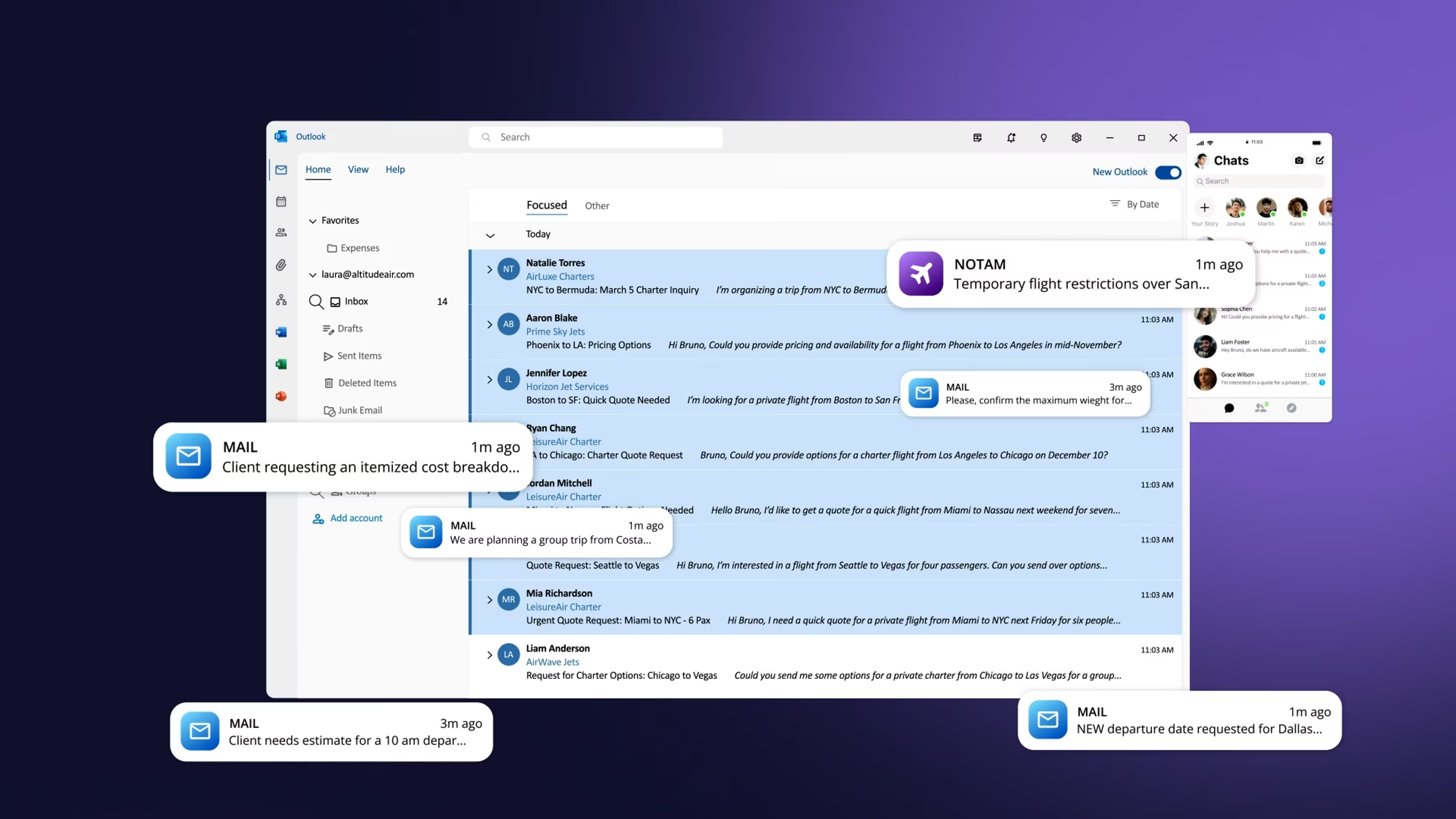
Ask any commercial team at a charter operator how their morning starts and you hear a version of the same story.
Requests have arrived overnight, through email, through WhatsApp, through marketplace platforms, through a forwarded thread that buries the actual ask somewhere in the middle. Some have full routing and dates. Some have a destination and a vague timeframe. Some are the same request arriving across multiple channels from the same broker, each slightly different.
None of it is structured. None of it is in the CRM yet. None of it has been turned into a quote.
And while the team works through this intake queue, the broker who sent those requests is waiting, and almost certainly sent the same request to other operators at the same time. In charter aviation, the first credible response wins a disproportionate share of the business. Everyone knows this. The bottleneck isn't ambition or effort. It's the time it takes to understand what's being asked before anyone can respond.
The intake problem nobody measures
There's a step in the charter workflow that almost never appears in operational reviews, technology roadmaps, or sales pitches. Call it intake, the process of turning an inbound request into something a commercial team can actually act on.
In most operations, intake looks like this: someone reads an email, figures out what's being asked, checks whether it's already in the CRM, manually creates or updates a record, extracts the routing and dates and passenger count and any special requirements, and then, and only then, begins the actual quoting process.
For a clean, complete request from a regular client, this takes five to ten minutes. For a fragmented request across multiple messages with missing information and ambiguous dates, it can take thirty minutes of back-and-forth before the quoting process even starts.
Multiply that across twenty to forty inbound requests per day for a mid-size operation, and intake is consuming somewhere between two and four hours of commercial team time daily, just to understand what's being asked. Before a single quote goes out.
The problem compounds because requests don't arrive in one place. A 2024 analysis of inbound demand patterns across charter operations found that the average request touches 2.3 communication channels before it's resolved, email plus at least one of WhatsApp, phone, marketplace, or SMS. Each channel has different structure, different context, different urgency signals.
Teams that are good at this have built personal systems: colour-coded inboxes, naming conventions, shared spreadsheets that track request status. These systems work until they don't, until someone is sick, until volume spikes, until the spreadsheet gets out of sync and a request falls through.
What happens when intake is slow
The downstream effects of slow intake are measurable, but most operators aren't measuring them.
Quote response time is the most visible. In a market where the same request goes to multiple operators simultaneously, the first credible response has a disproportionate conversion advantage. Internal data from Hamilton customers consistently shows that quotes sent within fifteen minutes of request receipt convert at roughly 2–3× the rate of quotes sent after two hours, not because the later quotes are worse, but because the broker has often already had a conversation with whoever responded first.
Duplicate effort is the quietest cost. The same trip gets entered into a CRM, then rebuilt in a quoting tool, then reformatted into a proposal, then re-entered into a dispatch system after booking. Information that arrives once gets typed four or five times. Each retype is not just overhead, it's a branching point where the data can diverge. A route that was LAX–TEB in the original request becomes LAX–KTEB in the CRM and Los Angeles to Teterboro in the proposal, and now the systems that are supposed to talk to each other are working from slightly different records.
Empty legs are perhaps the most expensive consequence. Empty legs exist, in part, because repositioning aircraft don't get surfaced to the right buyers fast enough. When intake is manual and commercial teams are processing requests reactively, proactive empty leg matching, identifying which inbound requests could be served by an existing reposition, requires attention and time that's already consumed by the intake queue. The commercial opportunity sits in the data. Nobody has time to find it.
The gap between "we use AI" and AI that actually works
The charter technology market in 2026 is full of products that claim to use artificial intelligence. Most of them mean one of two things: a rules-based automation that someone built without calling it that, or a bolt-on LLM wrapper that summarises text without connecting to anything operational.
Neither solves the intake problem.
Genuine AI-assisted intake means something specific. It means a system that can read an email from a broker in London, including the forwarded thread from two days ago, the PDF attachment with the client's preferred aircraft list, and the P.S. about needing kosher catering, and produce a structured trip record: origin, destination, dates, passenger count, aircraft preferences, special requirements, priority level, and broker relationship context. It means that when the same request arrives via WhatsApp twenty minutes later, the system recognises the duplicate and links it rather than creating a second record.
It means that when a request is missing information, the most common scenario, the system knows what's missing and either asks for it automatically or flags it for the commercial team with the specific gap identified, rather than surfacing an incomplete record and leaving someone to figure out why the quote tool won't accept it.
The difference between this and "we have AI" is that the structured record doesn't just exist as a data artefact. It flows. The CRM is updated. The quoting tool is pre-populated. The marketplace can be checked against the structured routing. The commercial team's job shifts from information processing to decision-making.
Why CRM data quality is an aviation-specific problem
Most CRM thinking in B2B SaaS assumes that information arrives in structured form, a form fill, an API, a standardised data entry workflow. The CRM is a repository for information that was already clean when it came in.
Charter aviation breaks this assumption completely.
Information arrives fragmented, across channels, often from brokers who have their own naming conventions, their own aircraft preferences encoded in shorthand, their own way of describing routing that assumes operational knowledge the CRM doesn't have. "KLAS to KTEB, pax 7, heavy iron preferred, need to block by EOD" is a complete and unambiguous request to an experienced charter professional and a parsing challenge for any system that wasn't built specifically for this context.
The operators who have the cleanest CRM data aren't necessarily using better CRMs. They've usually built internal discipline around data entry that consumes meaningful headcount. They have ops coordinators whose job is partly to be the human middleware between how requests arrive and how systems expect data to look.
Hamilton's approach is to eliminate that middleware layer, not by asking brokers to change how they communicate, and not by asking ops teams to maintain manual discipline, but by building intake intelligence that understands aviation context natively and produces clean, structured records regardless of how the request arrived.
What structured demand actually enables
The case for fixing intake isn't really about intake.
It's about what becomes possible when every inbound request exists as clean, structured operational data from the moment it arrives.
When demand is structured, quoting becomes fast by default. Aircraft matching runs against real routing and timing constraints, not free-text descriptions. Pricing logic can be applied systematically. The commercial team is choosing between options, not building them from scratch.
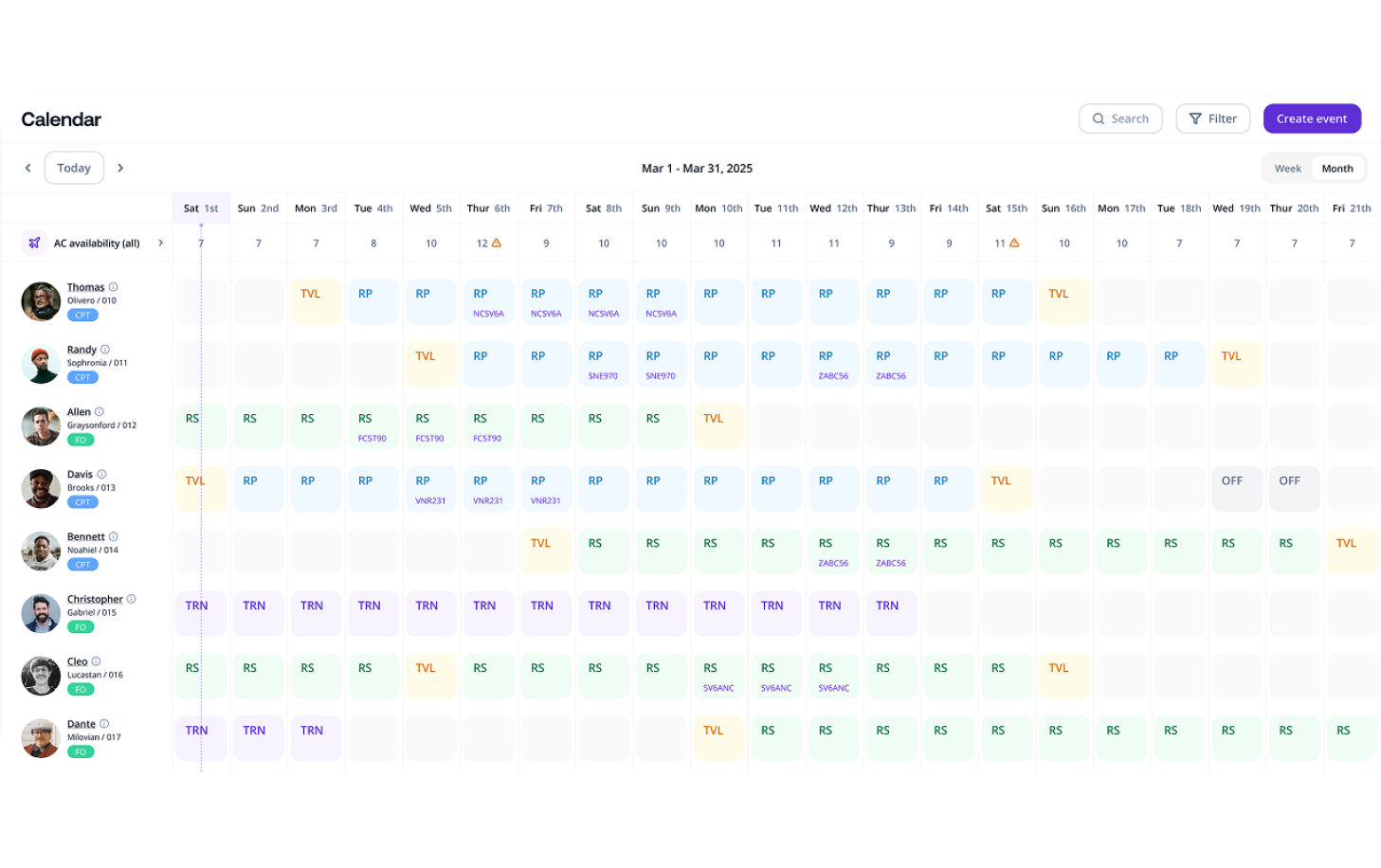
When demand is structured, empty leg matching becomes proactive. The system can continuously evaluate inbound requests against known repositions and flag commercial opportunities in real time, rather than relying on someone to manually cross-reference the incoming queue against the dispatch board.
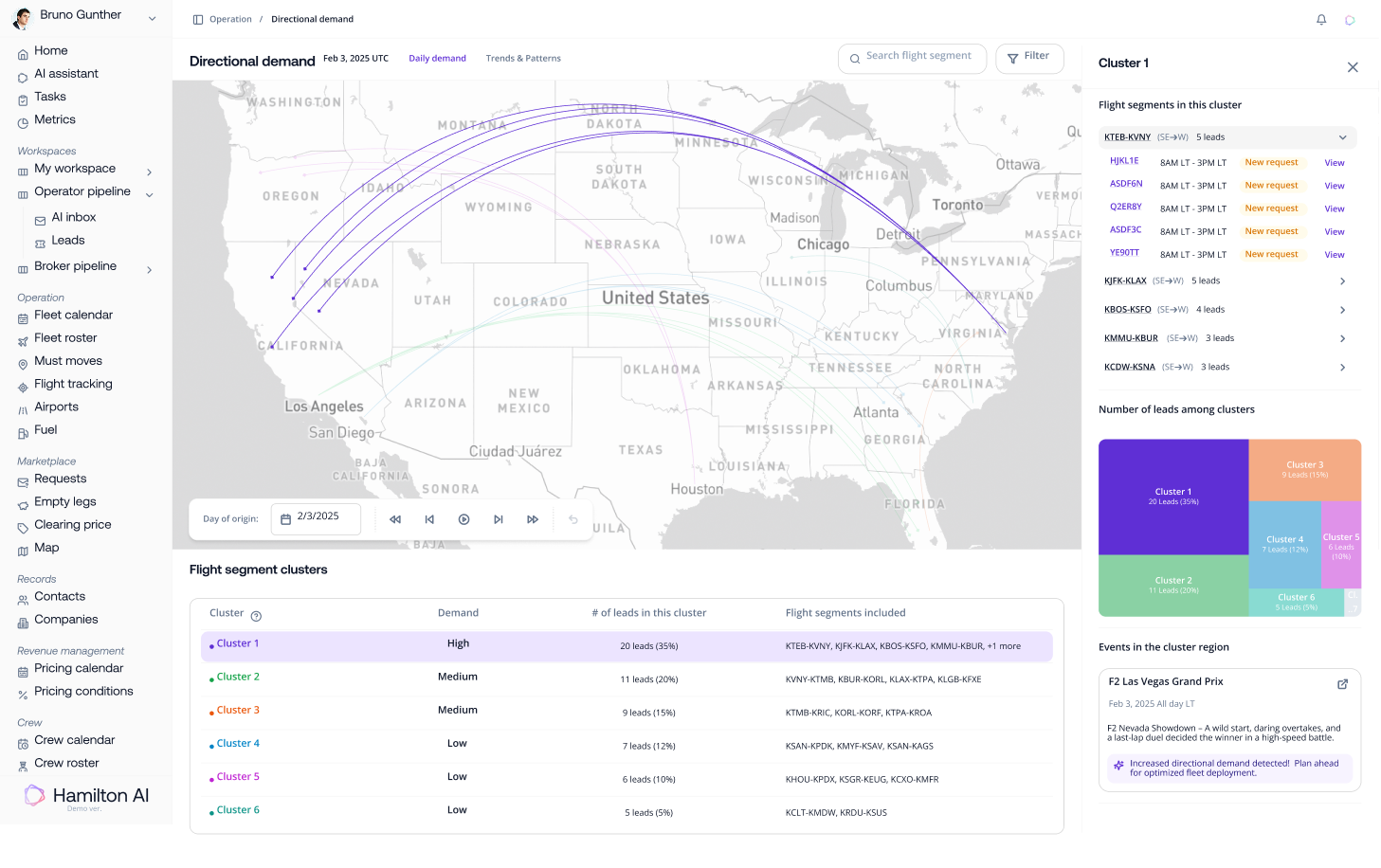
When demand is structured, forecasting becomes possible. Operators can see demand patterns by route, by broker, by aircraft type, by time of year — not from manual analysis of historical emails, but from the structured record of every request the business has ever received. This is data that most operators have in theory and almost none have in practice, because it's currently locked inside email threads.
When demand is structured, the entire downstream workflow connects. Quote flows from request. Proposal flows from quote. Booking flows from proposal. Payment and dispatch flow from booking. Every stage operates on the same record, and the information architecture that made intake fast is the same architecture that makes reconciliation automatic and audit trails complete.
The operators who win the next five years
Private aviation demand is structurally constrained. The global fleet is still roughly 3,000 aircraft short of pre-pandemic capacity, and lead times on new deliveries remain extended. Supply isn't going to fix the capacity problem in the near term.
Which means the operators who grow disproportionately won't do it by acquiring more aircraft. They'll do it by converting a higher percentage of inbound demand into confirmed revenue, faster, with less overhead, at better margins.
That's an information problem. Specifically, it's an intake problem. And it's one that the current generation of aviation software was not built to solve.
The operators who figure this out first will be operating with a structural advantage that's genuinely hard to replicate: not better aircraft, not better pricing, but a commercial machine that turns fragmented demand into confirmed, profitable trips faster than any competitor can match manually.
Hamilton AI is a full-stack platform for private charter operations, AI-powered intake, quoting, dispatch, banking, and compliance in one connected system. Built for Part 135 and Part 91 operators running 5 to 60+ aircraft.